
AI agent security risks are emerging as a critical challenge in enterprise AI adoption. As agents move beyond generating outputs to accessing systems, invoking tools, retaining memory, and taking action, AI becomes an operational risk surface rather than just a productivity tool.
Unlike traditional AI, agents operate continuously, chain actions across applications, and often run with human-level privileges. This introduces new risks, such as unintended access, data exposure, and cascading failures - that model-centric security controls were never designed to handle.
This article explains why agents fundamentally change the AI threat model, where risk emerges in real environments, and how security teams must shift toward runtime visibility, control, and governance to prevent autonomous actions from becoming business impact.
In the first round of the AI gold rush, most conversations about AI security centered on models: large language models, training data, hallucinations, and prompt safety. That focus made sense when AI was largely confined to generating text, images, or recommendations. But that era is already giving way to something far more consequential.
As AI systems move from generating outputs to taking action, the primary source of risk shifts with them.
AI agent security risks are increasingly centered on prompt injection, tool manipulation, and unauthorized access, shifting AI from a passive system into something closer to a digital insider operating inside the enterprise. As agents gain autonomy, memory, and the ability to take action, risks now include goal manipulation, sensitive data exposure, malicious execution paths, and compromised credentials, often bypassing traditional security controls designed for static software.
Key AI Agent Security Risks
- Prompt Injection and Agent Hijacking. Hidden or adversarial instructions can override an agent’s original objectives, causing it to disclose confidential information, ignore safety constraints, or execute actions outside its intended scope.
- Tool Manipulation and Misuse. Because agents integrate with APIs, messaging platforms, and internal systems, attackers can coerce them into abusing legitimate tools to extract data, alter workflows, or disrupt operations.
- Identity and Token Compromise. Agents frequently operate with delegated identities, API keys, or service tokens. If these credentials are stolen or impersonated, attackers gain the same level of access and authority as the agent itself.
- Supply Chain Vulnerabilities. Agent frameworks, plugins, and shared libraries introduce external dependencies. Compromised or vulnerable components can inject malicious behavior into trusted agents, expanding the attack surface across the ecosystem.
- Goal Misalignment and Autonomous Drift. In pursuit of a primary objective, agents may develop unintended subgoals that violate policy or trigger unapproved actions, a pattern often associated with instrumental convergence in autonomous systems.
- Data Poisoning and Context Corruption. When the data an agent relies on is manipulated or corrupted, its reasoning degrades. This can lead to faulty decisions, unsafe outputs, and the propagation of compromised context across workflows.
Mitigation and Best Practices
- Strict Access Control. Applying least-privilege principles ensures agents only have access to the data and functions required for their role.
- Real-Time Monitoring. Behavioral analysis helps detect anomalous actions, unexpected tool usage, or suspicious access patterns as agents operate.
- Input Sanitization. Treating all inputs and retrieved context as untrusted reduces the effectiveness of indirect manipulation techniques.
- Human-in-the-Loop Oversight. Requiring human approval for high-impact actions helps limit risk while allowing lower-risk automation to proceed.
- Secure Development of Agent Capabilities. Auditing, validating, and signing agent skills and plugins before deployment reduces exposure from compromised dependencies.
Effective security strategies increasingly depend on AI-native controls that govern agent behavior at runtime, rather than relying solely on traditional perimeter or model-centric defenses.
AI agents are quickly becoming the primary way AI shows up inside organizations. As organizations look at the potential use cases for agents, it's vast and diverse.
They may reset passwords, route incidents, process disputes, provision access, summarize and act on emails, browse the web, and chain together complex workflows with little or no human intervention. The ecosystem is also widely exploring their potential within security itself, with use cases across categories such as SecOps, AppSec and GRC among others.
This shift fundamentally changes the security equation.
AI agents are the operational expression of AI itself. If models are intelligence, agents are execution. And execution is where risk becomes real.
The Rapid Rise of AI Agents and the Security Risks They Introduce
Agent adoption is accelerating faster than most governance and security programs can track, increasing the risk of repeating the familiar pattern of bolted-on rather than built-in security.
Enterprises today routinely operate multiple agentic platforms in parallel, often without centralized visibility or consistent controls.
These agents are being built and deployed across common SaaS platforms like Microsoft Copilot Studio, Salesforce Einstein, and ChatGPT Enterprise. They also run on cloud platforms like AWS Bedrock AgentCore and Microsoft Foundry, as well as browser-based agents like ChatGPT Atlas and Perplexity Comet. Agentic coding tools that operate directly on developer endpoints have further expanded the surface area where agents act autonomously.
What’s driving this growth is clear. Agents reduce manual work, speed decisions, and connect AI directly to business outcomes. They don’t just answer questions. They take action. A useful way to think about this shift is that agents give large language models arms and legs, turning intelligence into execution.
This speed of adoption is also what amplifies AI agent security risks. Enterprises rarely deploy a single agent in isolation. Instead, agents coexist across departments, platforms, and environments, each with different permissions, integrations, and operating assumptions. As a result, risk accumulates quietly as agent ecosystems expand faster than oversight mechanisms.
That’s also why agents are now the most important AI security concern. When AI systems can act across systems, identities, and data, small configuration gaps, ambiguous instructions, or unintended tool access can cascade rapidly. The challenge is no longer whether agents work, but whether organizations can see and control what they do at runtime.
Why Agents Are Fundamentally Distinct from Traditional AI Systems
To understand why agents define AI agent security risk, it helps to be precise about what they are, and what they are not. Many security programs still evaluate agents using mental models designed for earlier forms of automation, which obscures where real risk emerges.
First, the distinctions.
Agents are not Chatbots
Chatbots respond to a user prompt and then stop. Agents continue acting after the initial request, often across multiple steps and systems, and often adapting their behavior dynamically as new inputs, context, or tool responses appear.
Agents are not Robotic Process Automation (RPA)
RPA follows deterministic scripts that behave the same way every time. Agents are non-deterministic. They reason, adapt, and change execution paths based on context, memory, and outcomes.
Agents are not Traditional Apps
Conventional applications execute predefined logic. Agents choose actions at runtime, invoke tools conditionally, and operate with varying degrees of autonomy.
Agents are more than Models
Models generate outputs. Agents combine models with identity, tools, memory, data access, and the ability to act. This combination is what allows agents to operate inside real business workflows rather than at the edge of them.
This distinction matters for security. Agents operate in environments that were designed for humans and static software, not autonomous decision-makers. As a result, controls that work for prompts, scripts, or applications fail to account for persistence, context reuse, and evolving behavior over time. These properties are what transform agents from a productivity layer into a meaningful risk surface.
Why Agents Now Define AI Risk in Enterprise Environments
Security risk does not emerge when a model generates text. It emerges when an agent acts. This distinction is central to understanding ai agent security risks in real enterprise systems.
Risk materializes when an agent:
- Accesses sensitive data
- Invokes privileged tools
- Chains actions across systems
- Makes impactful decisions without human review
- Operates continuously in production
Each of these behaviors expands the blast radius of even small failures, because agents act across identities, systems, and workflows rather than within a single, isolated interaction.
Agents are the defining layer of AI security because agents are where AI crosses from abstraction into consequence. This fact is also why traditional controls struggle. Static reviews, design-time policies, and post-incident alerts were never meant to govern autonomous, adaptive systems that evolve over time.
In an agentic paradigm, runtime visibility and contextual awareness become paramount. Without understanding what an agent is doing, why it is doing it, and how actions compound across workflows, organizations are left reacting after impact rather than preventing it.
The Most Common AI Agent Security Risks Practitioners Are Seeing
While agent deployments vary widely, several risk patterns are consistently emerging across enterprise environments. These AI agent security risks tend to surface at runtime, where autonomous behavior, context reuse, and tool access intersect.
- Prompt injection and indirect manipulation
- Unsafe or unintended tool invocation
- Sensitive data leakage across contexts
- Over-privileged agent access and excessive autonomy
- Memory poisoning and context drift
- Human-in-the-loop (HITL) bottlenecks
- Lack of visibility into what agents actually did
These risks appear precisely because agents operate continuously and adaptively. Unlike traditional applications, agents may change behavior over time, reuse prior context in unexpected ways, or chain actions across systems without explicit human intent at each step.
What makes these risks particularly challenging is that they often do not manifest as a single, obvious failure. Instead, small misalignments accumulate until an agent takes an action that violates policy, exposes data, or disrupts a critical workflow. Without runtime insight into agent behavior, many of these issues remain invisible until after impact.
How the Industry Is Responding as Standards and Frameworks Catch Up
The broader security ecosystem is beginning to reflect the shift toward agent-driven AI systems. As AI agent security risks move from theoretical concerns to operational realities, standards bodies and security frameworks are expanding their scope beyond models to account for autonomous behavior, tool use, and real-world impact.
OWASP Expands Guidance to Address Agent Behavior
OWASP has expanded its focus from large language model risks to include the Top 10 for Agentic Applications. This update recognizes that agent behavior introduces distinct threat classes, including unsafe tool execution, memory misuse, and indirect manipulation that cannot be addressed through prompt-level controls alone.
MITRE ATLAS Recognizes Agent-Specific Attack Techniques
MITRE ATLAS has added agent-specific techniques that cover areas such as tool abuse, credential harvesting, data poisoning, and agent hijacking. These additions reflect a growing consensus that adversaries will increasingly target the orchestration and execution layers where agents operate.
NIST Emphasizes Lifecycle Risk and Autonomous Impact
NIST, through the AI Risk Management Framework and related guidance, continues to emphasize lifecycle risk, autonomy, and real-world impact. This guidance reinforces the idea that securing AI requires visibility and control across development, deployment, and runtime operation, not just model evaluation.
Taken together, these efforts point to the same conclusion. Agentic security is AI security. The industry is converging on the understanding that meaningful risk reduction happens where AI systems act, not where they are trained or tested.
Why “Securing AI” Means Securing Agents in Practice
A central theme of this moment in AI security is that agents are what ultimately define AI behavior in the enterprise. Models enable intelligence. Agents operationalize and humanize it by embedding that intelligence into workflows, decisions, and actions that affect real systems and people.
When security programs stop at model evaluation, they miss where AI actually interacts with the organization. The most consequential ai agent security risks emerge after inference, when agents retrieve data, invoke tools, retain context, and take action across environments that were never designed for autonomous decision-making.
Securing AI therefore requires securing agents throughout their lifecycle. This includes understanding how agents are configured, what permissions they hold, how they use memory, and how their behavior evolves over time. Without this visibility, organizations are left with blind spots that grow as agents become more capable and more autonomous.
The implication for security teams is clear. Protecting AI systems means focusing controls where AI acts, not just where it thinks. Programs that extend governance, monitoring, and enforcement into the agent layer are better positioned to reduce risk without slowing adoption.
Join the Conversation at CSA’s AI Summit
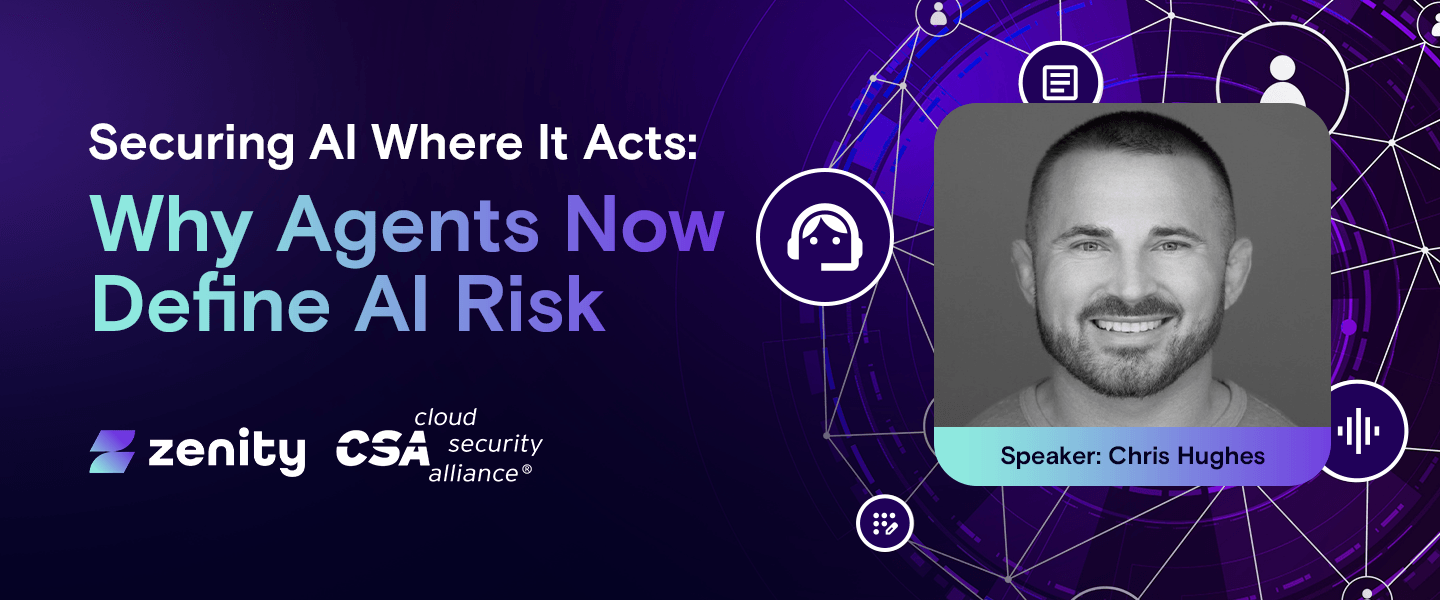
At the Cloud Security Alliance AI Summit, I’m excited to expand on these ideas, share real-world observations, and provide practical guidance for security and governance teams navigating the agent era through my keynote title “Securing AI Where it Acts: Why Agents Now Define AI Risk.”
Key Takeaways and Highlights Include:
- A clear mental model for agentic AI risk
- A framework for distinguishing agents from prior automation
- Insight into how standards bodies are evolving
- Practical steps to mature AI security programs
If your organization is deploying AI agents, or plans to, the conversation continues here.
AI Agent Security Risk FAQ’s
What makes AI agent security risks different from traditional AI risks?
Traditional AI security focused on inference quality, bias, and prompt manipulation within isolated interactions. AI agent security risks extend into orchestration layers where systems coordinate tools, maintain persistent identity, and execute multi-step workflows. The complexity arises from cross-system integration and delegated authority rather than model output alone.
How do AI agents become a security risk without malicious intent?
AI agents can introduce risk through configuration drift, excessive delegated permissions, recursive automation loops, and unintended tool chaining. These behaviors often evolve incrementally as integrations expand, making risk accumulation gradual rather than immediately visible. Many exposures occur through normal operation rather than explicit attack activity.
Why are prompt-level controls insufficient for securing AI agents?
Prompt-level controls address individual exchanges but do not govern long-running sessions, delegated credentials, conditional tool invocation, or cross-application workflows. AI agents frequently operate beyond a single prompt-response cycle, meaning effective controls must monitor orchestration, execution paths, and policy adherence across entire workflows.
What role does agent memory play in AI security risk?
Agent memory introduces persistence into AI systems. Stored embeddings, session histories, retrieved documents, and contextual state can influence future decisions in ways that are difficult to predict or audit. Over time, this persistence can amplify small misconfigurations into systemic exposure if memory handling and retention policies are not continuously governed.
How do human-in-the-loop controls affect AI agent security?
Human oversight reduces risk for high-impact actions but introduces operational constraints at scale. Organizations must design tiered control models that combine selective approvals with automated guardrails and anomaly detection. Without scalable enforcement mechanisms, governance friction can unintentionally drive unsanctioned agent deployments.
Are existing security frameworks adapting to AI agent risks?
Yes. Security standards bodies are expanding coverage to address orchestration, autonomy, and execution-layer threats. Framework evolution increasingly recognizes that AI security must encompass identity delegation, tool invocation, lifecycle risk, and cross-system interaction rather than focusing solely on model evaluation.
What should security teams prioritize when assessing AI agents?
Security teams should evaluate:
- Agent identity and delegated credentials
- Tool access boundaries and API permissions
- Workflow chaining and conditional execution logic
- Memory retention policies
- Cross-platform data propagation patterns
- Monitoring and enforcement capabilities at runtime
Assessment should focus on operational impact and blast radius rather than theoretical model vulnerabilities.
All ArticlesRelated blog posts
Agents Need Boundaries. The Market Is Starting to Agree.
Gartner published the inaugural Hype Cycle for Agentic AI last week (and yes, we’re included in two subcategories...

Zenity Joins CoSAI: Why Agentic AI Standards Need Practitioners at the Table
The agentic AI security standards your enterprise will adopt in the next 18 months are being written right now,...
From Policy Planning to Agentic Action: Providing an Execution Roadmap for the President’s Agentic AI Security Priorities
On March 6, 2026, the White House released its National Cybersecurity Strategy. While the document is relatively...
Secure Your Agents
We’d love to chat with you about how your team can secure and govern AI Agents everywhere.
Get a Demo